

Treated
varieties
Maluma Hass, Hass, HMR
Temperature
range
8℃-35℃
Altitude
700-1100
meters
Trees age
>5 years
Avg. humidity
35%
Avg. female
flowering
4 hrs/day
Pollination
season
week 34-week 38
# of hives/
hectare
1-2
Treated area
15 hectare
Allesbeste is a leading and innovative avocado-growing company based in the Limpopo Province of South Africa, which partnered with BloomX to improve pollination efficiency and fruit quality. After a successful collaboration, the results were outstanding, demonstrating the effectiveness of BloomX’s pollination solutions.
The Allesbeste team had experienced low yields and wanted to evaluate new technologies to help increase yield.
The avocado tree requires cross-pollination to produce strong, high-quality fruit. This process depends on the interaction between Type A and Type B avocado varieties, where one serves as the pollinizer and the other as the recipient, with flower opening and closing synchronized accordingly. However, few people realize that avocado species evolved primarily in Central America, where native pollinators – not honey bees (Apis mellifera) – played a key role. Honey bees were introduced to the Americas from Europe, and in areas lacking native pollinators, farmers have had to rely on them, often with limited success. One reason is that honey bees are not particularly attracted to the nectar of Hass avocado flowers, which contains high levels of potassium – a compound bees tend to avoid. As a result, visitation rates to Hass flowers are relatively low, leading to reduced pollination efficiency.
Climate change has also exacerbated pollination problems in avocados. According to recent studies1 temperatures in avocado-growing areas in the Limpopo Province have increased significantly in recent decades. This temperature rise affects fruit development as well as the behavior of honey bees, who are active only between 13–35°C (55.4–95°F).
BloomX biomimetic approach imitates the way pollination is done by avocado’s natural pollinators. YAHAV 1400 collector device uses electrostatic charge to stroke the perimeter of one avocado variety to extract its sticky pollen grains. These grains are gathered onto reusable frames placed on a YAHAV 1400 deployer device, which are then transmitted to the same or different variety of avocado during the most effective pollination window provided by BloomX app.
BloomX deployed its YAHAV 1400 kits to pollinate 15 hectares (37 acres) of avocado, with 7 additional hectares (17 acres) used as control plots chosen by Allesbeste. The treatment included both self and cross pollination methods and between 1 to 3 repetitions for each treated plot. The treated area was divided into blocks, to ease the measuring system.
Pre-field
Check app for the daily effective pollination window
Field
Extract pollen grains from the anthers of a male flowering tree using YAHAV 1400 collector device
Store the reusable frames coated with pollen grains in a designated bag
Attach the frames to the YAHAV 1400 applicator device and apply the pollen grains to a female flowering tree
Allesbeste’s results show an average increase of 16.5% productivity. In some of the blocks, numbers peaked to 20.23%, whereas the minimal increase was 3.13%. This increase represents an average increase of 2 tons per hectare (cross-pollination results climb up to 3 tons per hectare).
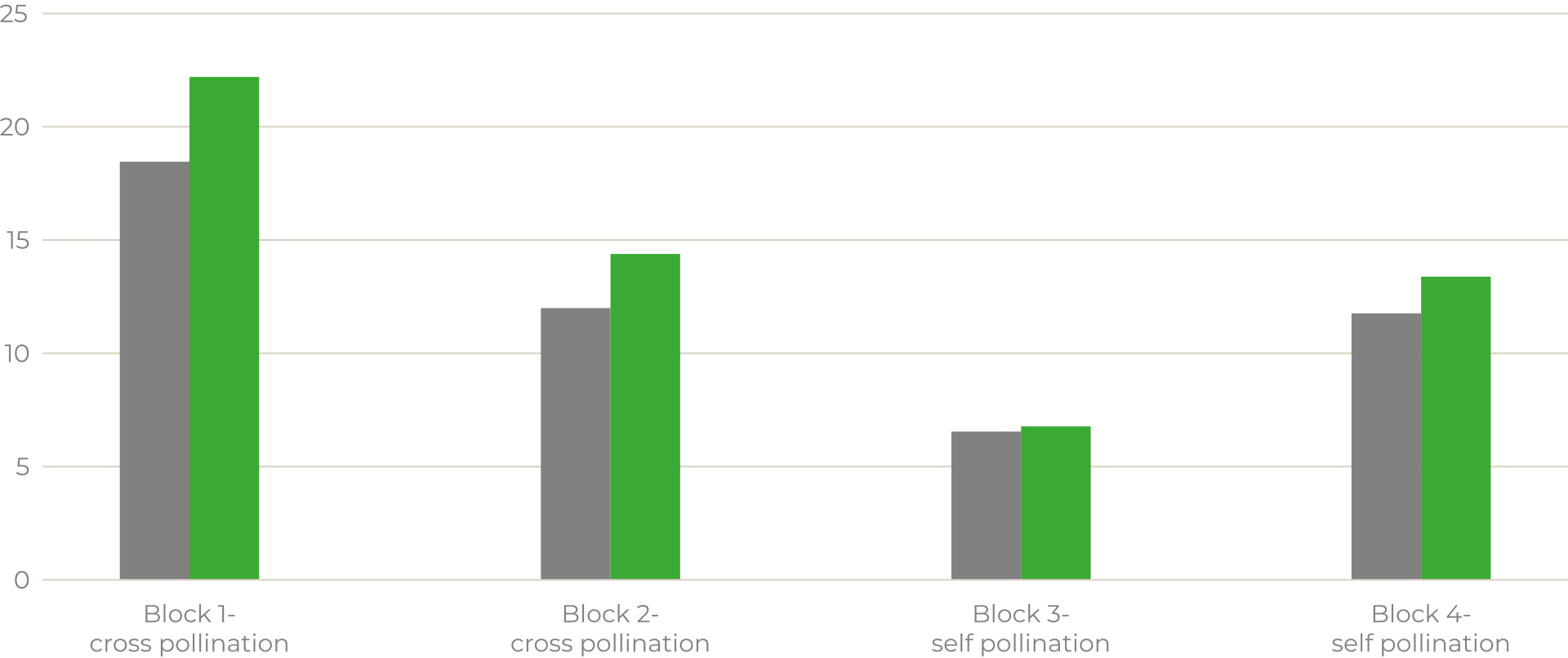
The collaboration between Allesbeste and BloomX highlights the significant impact of advanced pollination technologies on crop yield and quality. This case study underscores the potential for innovative solutions to address pollination challenges in the agricultural industry.
Allesbeste and BloomX will continue their work together in the upcoming season and will test the influence of pollination on alternate bearing.
This cyclical pattern of alternate bearing is often influenced by the plant’s energy and nutrient reserves. In a “heavy” year, the tree uses a significant amount of resources for fruit production, leaving fewer resources for the development of flower buds for the next season. This results in a “light” year with lower fruit production. Factors like tree health, environmental conditions, and management practices can affect the severity of alternate bearing.
Better pollination can positively affect the alternate bearing phenomenon. Improved pollination can lead to a more consistent and balanced fruit set each year, which helps stabilize the tree’s energy and nutrient use. By ensuring a more uniform crop load annually, better pollination can reduce the extreme fluctuations between heavy and light bearing years, thereby mitigating the impact of alternate bearing. This can result in more stable and predictable yields for growers.
Another test would be of the fruit quality – Good pollination can lead to better fruit development overall, improving attributes such as size, shape, and potentially even the taste and nutritional quality of the avocados. The focus of this test will be in the fruit size.