
Pollination in avocados works differently from other crops. The way avocado flowers open and operate determines when pollination can occur, and plays a major role in whether fruit will form.
How Avocado Flowers Work
When observing an avocado tree, you’ll notice that its flowers function either as male or female at different times of the day. This behavior depends on the variety’s flowering type.
Type A varieties (such as Hass) typically have most of their flowers open in the female phase during the morning, and in the male phase the following afternoon.
Type B varieties (such as Ettinger or Fuerte) follow the opposite pattern – female in the afternoon, and male the next morning.
This complementary timing creates daily windows in which Type A trees are receptive to pollen while Type B flowers are exposing pollen for pollinators to collect, and vice versa, enabling cross-pollination between the different types.
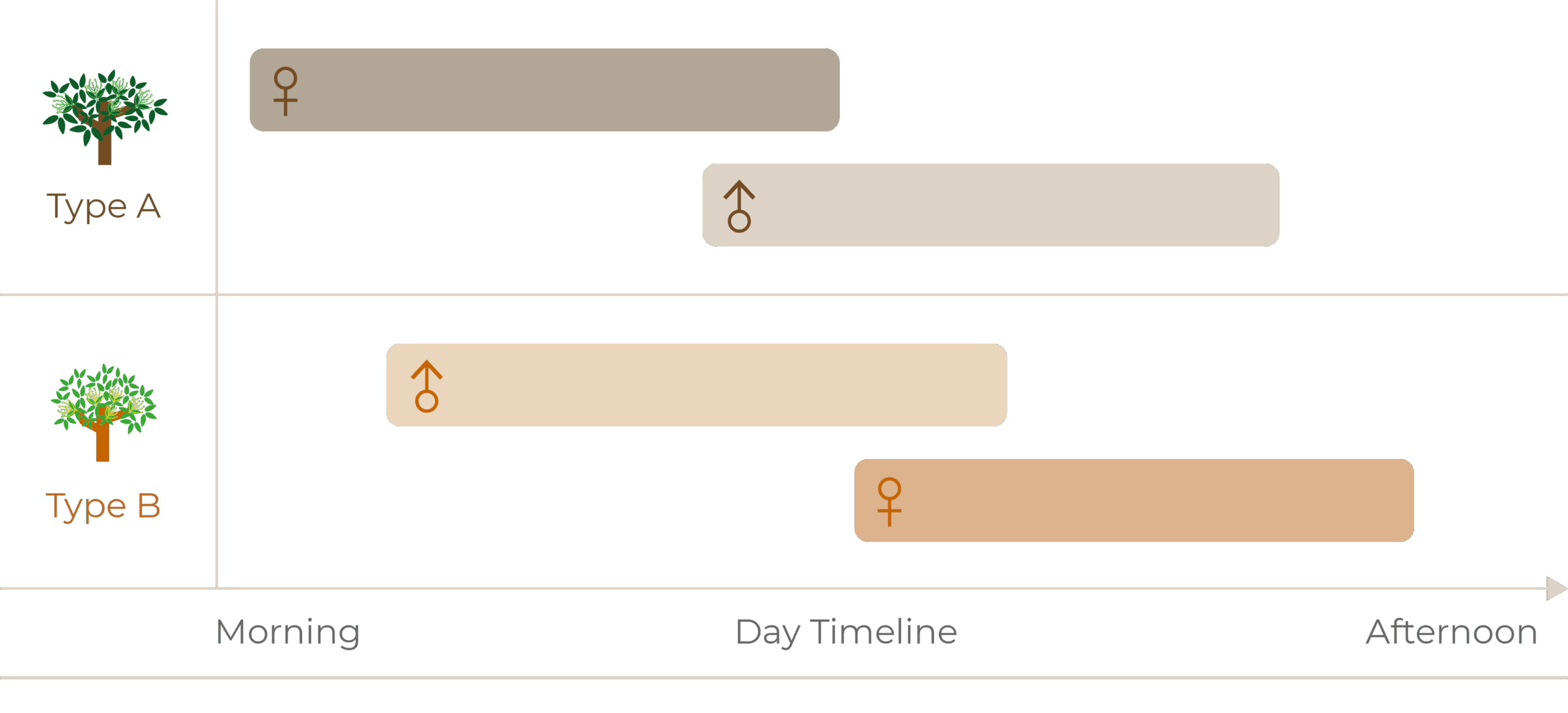
Avocado flowering is a continuous daily cycle: each day, thousands of new flowers open, while a similar number complete their cycle and fall from the tree.
On a single tree, the male and female phases of its flowers are usually separated by time, and rarely overlap. That’s why planting a mix of Type A and Type B varieties helps ensure that at least one tree is releasing pollen when another is receptive, creating better conditions for successful pollination.
Regional Differences in Pollination Patterns
Pollination success depends on factors like climate, varietal mix, and orchard layout.
- In tropical or subtropical regions (Mexico, Colombia, etc.):
Warm and stable conditions can create more overlap between male and female phases on the same tree, allowing more self-pollination. - In cooler or coastal climates (Chile, Israel, etc.):
The timing of flower phases on the same tree does not tend to overlap (or overlaps shortly), making cross-pollination between varieties more important for good fruit set.
Where BloomX Fits In – Supporting Both Strategies
Whether your orchard depends more on self- or cross-pollination, BloomX offers solutions to improve pollination outcomes.
- For self-pollination planting:
BloomX is not limited by the short natural overlap between flower phases. Our tools allow pollen to be collected during male hours and applied during any part of the female ‘window’, even when timing doesn’t naturally align. - For cross-pollination setups:
BloomX lets growers select specific varieties to collect pollen from and apply that pollen precisely when female flowers of the target variety are receptive.
This flexibility gives growers more control over the pollination process, helping increase certainty even when honey bee activity is low or weather conditions are unpredictable.