
From morning smoothies to fresh salads, pollination touches more of our meals than we often realize. Fruits like avocados, blueberries, and almonds heavily depend on pollinators to grow.
Pollination isn’t just a background process – it’s essential to global food production. Roughly one in every three bites of food we consume relies on pollinators. Yet this global system is under growing stress, and simply adding more honey bee hives isn’t going to fix it.
Nature’s Real Pollinators
Honey bees (Apis mellifera) often steal the spotlight – and for good reason. Domesticated for centuries, they’re easy to manage and have become the backbone of commercial pollination services. In fact, the number of managed hives has grown by over 80% in the last century, following rising demand.
But nature was never meant to rely on a single species.
There are over 20,000 wild bee species around the world, each uniquely adapted to specific plants and conditions. These wild pollinators, from solitary ground-nesting bees to buzz-pollinating bumblebees, play critical roles in maintaining food production and biodiversity.
Take apples, for example: while tens of thousands of honey bees may be needed per hectare, just a few hundred Osmia cornuta (a solitary bee naturally suited to apples) can outperform them.
This video shows the difference in action
A Silent Crisis: Wild Pollinators Are Disappearing
Wild pollinators are in decline – and that’s a problem for both nature and agriculture.
Estimates suggest we may have already lost 25% of wild bee species. The main drivers include habitat loss, pesticide use, and climate change – but that’s just part of a broader, complex picture.
Why Honey Bees Alone Can’t Save Us
In response, many growers have turned to honey bees to fill this gap – especially in places like the U.S., where two-thirds of all hives are now used for commercial pollination, largely in almond orchards.
But this strategy has limits.
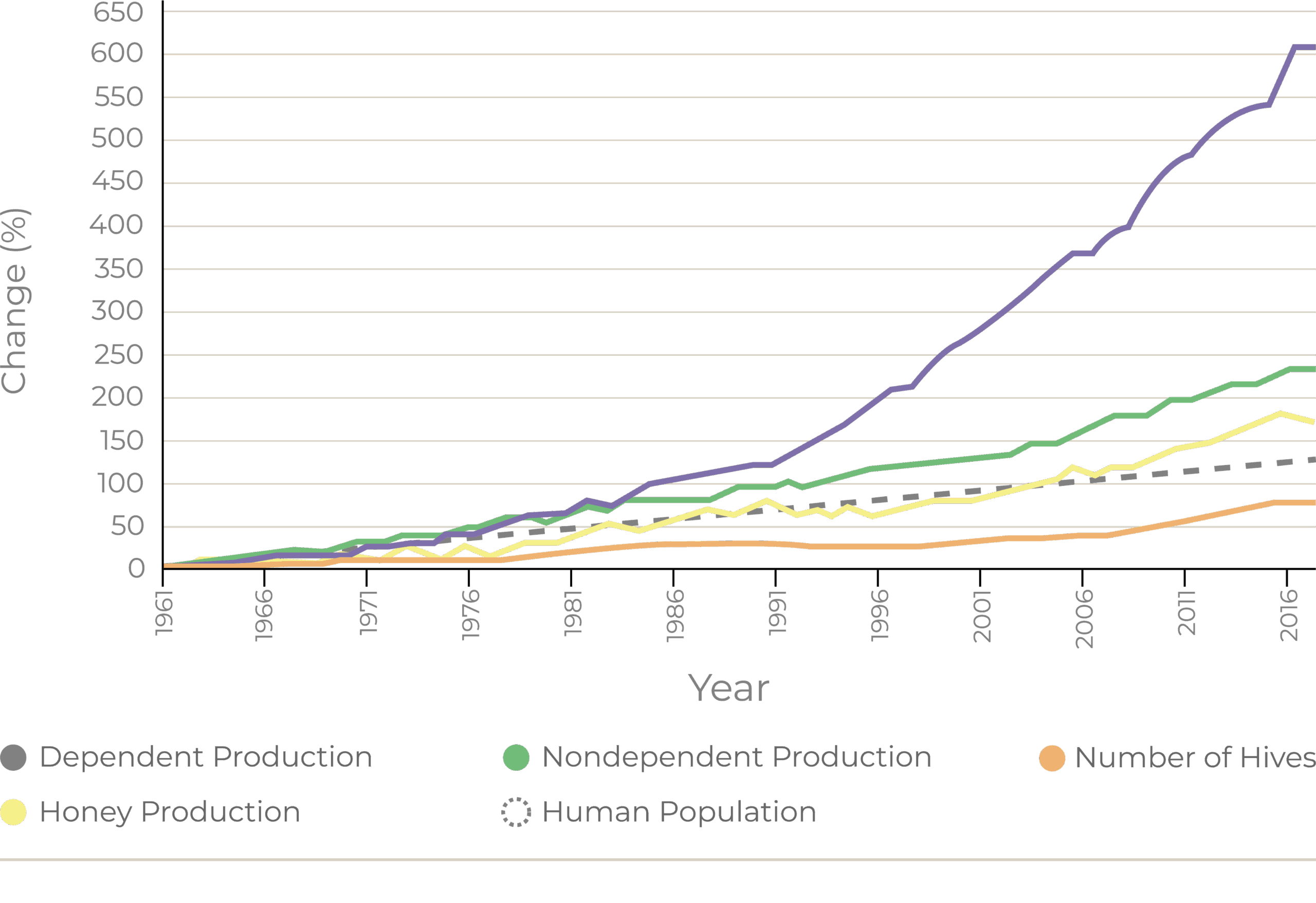
First, there’s a growing imbalance:
Pollinator-dependent commercial crops areas continue to expand, while honey bee populations aren’t keeping pace.
Source
Second, the limitation is not just about numbers – it’s biological.
- Honey bees are generalists. They cannot replace the specialized services provided by many wild bee species.
- Not all flowers attract honey bees, they may avoid blooms with low sugar or high potassium nectar.
- Their foraging hours don’t always match crop flowering windows, a challenge that is becoming more pronounced with climate variability.
We’ve demonstrated these effects clearly in avocado.
And most importantly, pollination works better with diversity.
Yields are higher when crops are visited by a variety of pollinators, not just honeybees.
Where BloomX Comes In
This is where BloomX steps in.
We don’t replace honey bees, we complement them. Our bio-mimicking pollination technology fills in the gaps where nature struggles or honey bees fall short: early morning, cloudy days, flower types that honey bees ignore, or regions with low wild pollinator presence.
By mimicking the mechanical and electrostatic properties of the crops’ natural pollinators, BloomX can ensure each flower gets a fair shot – even under challenging conditions. And we do this without harming existing pollinator communities.