
Between one siren and the next, I spoke with Ofri Yungerman – a farmer from Kibbutz Eyal who has been growing avocados for over a decade. Over the years, Ofri has adopted a clear approach: advanced agriculture relies on technology – not as a substitute for nature, but as a tool to manage it more precisely and efficiently.
About six years ago, when he first began working with BloomX while it was still in its early development stages, it was, for him, an investment of time and trust. Since then, season after season, he has expanded the use of the technology in his orchards, to the point where he recently chose to invest in the company as well.
“We had a heatwave that lasted almost two weeks,” he recalls, “and for about half of the flowering period, there simply were no bees in the orchard.”
That moment – when a critical process was completely out of his control – became a turning point, leading him to rethink pollination.
Ofri, tell us about the moment you realized pollination is not something you can leave entirely to nature.
From the very beginning, when I entered agriculture and started realizing how things work, I saw that we control almost every input in the production chain – fertilization, irrigation, pruning, harvesting. Everything is measured, planned, and managed.
But there’s one element we have no control over at all – pollination.
There, we depend on an insect. We can’t schedule it, can’t direct it, can’t send it to a specific place. In practice, we’re gambling.
The only thing we do is place hives and hope for the best. And all developments over the years have still revolved around bees – nothing beyond that.
There was one moment that really sharpened this for me. A year after the big heatwave – everything bloomed perfectly, but the bees simply didn’t come to the trees. Suddenly you realize: an entire industry depends on something you have no control over, and that’s not proper risk management.
What did pollination look like in your orchard before introducing BloomX technology?
“The biggest issue was inconsistency – that variability between ON and OFF years (i.e., alternate bearing). One year we had 1.5 tons per dunam, and the following year only 900 kilos, sometimes even less. You can’t run a business like that. Not workforce, not operations, not financing – everything keeps changing.
What the technology brought is consistency: the ability to create a relatively straight yield curve over the years. And for me, that’s the real win. Because in agriculture, even when there’s fruit on the trees, it still doesn’t mean anything – there’s still a long way until it’s sold.
But if you can stabilize yield, you can start planning.”
Why is stability so critical for you as a grower?
First of all, because of labor. I have a fixed team that I pay every day. If there’s no yield, there’s no work for them – but I still pay. In high-yield years, I need to bring in more workers. There’s no balance.
Beyond that, there’s also a mental aspect. In a year with no yield, you walk through the orchard every day and see nothing. You’re working, but it feels like you’re working for free.
And there’s also financing. I need to cover millions of shekels in expenses every year. Without stability, it’s very difficult to deal with management, budgets, and financing. In the end, management wants to see a stable business. You can’t operate with extreme volatility.
How do environmental conditions affect pollination?
You don’t need extreme events to impact pollination. A cold day, slow warming in the morning – bees come out late and miss flowering. Strong winds? They don’t come out at all. Sharp temperature changes? That alone can reduce activity.
There are many small variables that affect it – and that’s exactly the point: we have no control.
What made you work with BloomX when the technology was still in its early stages?
There were three things.
First, they addressed the most sensitive point: pollination. Even before I met them, I knew this was the weakest link that wasn’t being properly addressed. And even when solutions existed, they focused on bees – but you can’t control bees, so those weren’t good enough solutions.
Second, the approach. The BloomX team wasn’t trying to invent something new – they were trying to replicate nature. That’s scientifically very sound.
And third, the people. They had fire in their eyes. I saw they came to solve a real problem, not just run another experiment.
How did the work with BloomX evolve over the years?
It’s a process that requires a lot of patience. Each experiment takes almost a year before you see results.
We started very small – a few dunams, then dozens, then hundreds. The scale-up was slow but steady. There were also many voices saying it wouldn’t work – a lot of them. But that only gave the team more motivation to prove otherwise. Over time, we started seeing excellent results, year after year.
The major leap was the transition from the manual product – which worked very well but wasn’t scalable – to the new robotic solution. That’s when it started to feel like a real market solution. It requires almost no labor and works at scale.
What results have you seen in yield?
If I had to summarize everything in one number, we see an average improvement of about 25%–26% in yield, and it’s consistent over the years. But it’s not just one number – it varies by season, conditions, and treatment intensity.
Over the past four years, the data looks roughly like this:
- 2021–2022 season: ~7%-16% improvement
- 2022–2023 season: ~26% average, with peaks around 50% and lows around 10%
- 2023–2024 season: ~26% average, with peaks around 57%
- 2024–2025 season: ~36% average, with very high peaks (also above 50%)
So even as conditions change – we see consistent improvement, not a one-time effect.
But more importantly, it’s not just the average – it’s what happens at the extremes. There were plots with very low yield: 200-400 kg per dunam without treatment, versus 600–900 kg with treatment.
In agriculture, that’s the difference between loss and profit.
Did you also see an impact on fruit quality, beyond yield?
Yes, and initially we didn’t even measure it. At first, all our focus was on yield: how much fruit we got, whether there was an increase.
But at some point, we realized something else was happening. This started after work by Vered Yachimovitz (a senior researcher at the Volcani Institute), who showed that cross-pollination leads to more stable, larger fruit, and fruit that performs better under extreme conditions like heatwaves.
Once we understood this, we began systematically analyzing quality – sorting results, size distribution, and overall fruit quality.
We found a clear impact. Not just more fruit, but larger, more uniform fruit, and ultimately, more valuable commercially.
For example, in a recent trial in a BloomX pollinated plot, we saw a difference of about 0.10 NIS per kilo between treated and untreated tanks, purely due to better size distribution. At our scale, that adds up to significant money.
You also have an organic orchard where you used BloomX. What did you see there?
It becomes even more interesting there, because conditions are more challenging.
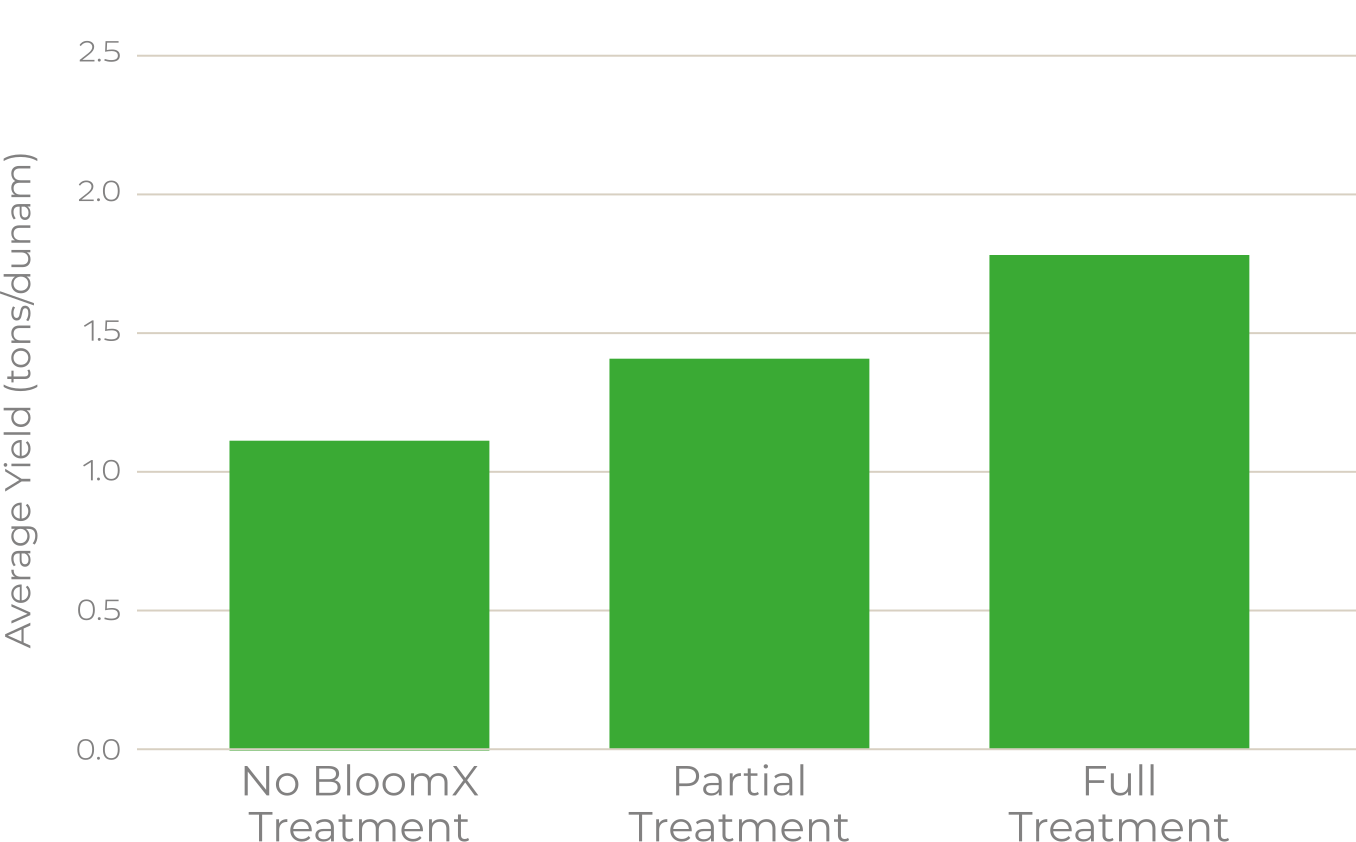
I have an organic orchard divided into four plots, each with a different treatment level over four years:
- No treatment: ~1.1 tons per dunam
- Partial treatment (2 out of 4 years): ~1.4 tons per dunam
- Full treatment (all 4 years): ~1.7 tons per dunam
The differences are significant – and in organic farming, that has huge financial implications.
Looking at a specific year:
- Plot average: ~2.1 tons per dunam
- Treated areas: up to ~2.7 tons per dunam
And remember – all these trials are done on half plots (half treated, half not). If the entire orchard were treated, the gap would be even larger.
Organic Orchard: Yield by BloomX Treatment Level
Recently, you decided to invest in the company. What led to that decision?
It’s very simple – we see the yield increase, the quality improvement, and most importantly the consistency – all happening in our orchard. This is no longer a field trial.
When you work with a technology for several years and see the results with your own eyes, there’s no reason to doubt. It simply becomes part of how we operate.
But it doesn’t end there.
We are in a situation where one of the most critical factors in agriculture – pollination – is also the least controlled.
And dependency on bees is only becoming more complex. Today we operate at a ratio of about one hive per two dunams. In the future, the availability of high-quality hives may decline, and we could reach a ratio that no longer meets industry needs. This is not theoretical – it’s around the corner.
Once we understood that this is a bottleneck for the entire industry, and we saw a solution that works – it changed how we think.
We’ve also seen the BloomX team from the beginning – how they progress, improve, and don’t stop until it works.
So for us, it wasn’t just about using the technology. It was about being part of something that can impact far beyond a single orchard.
And we want to be part of that solution.